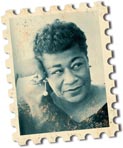
Ella Fitzgerald, my favorite singer of all time in any genre, winner of 13 Grammys, the Kennedy Center Award, an honorary doctorate in music from Yale University, The National Medal of Art from President Ronald Reagan, and The Presidential Medal of Freedom from President George H.W. Bush, has just been honored with a postage stamp.
Her singing style can best be described as effortless. She was a vocal marvel, blessed with perfect pitch and clarity of tone, a 3-octave range, incredible taste, and a talent for improvisation. During her fifty-seven year recording career, she sang with big bands, duos, trios, and symphony orchestras in a variety of styles ranging from the standards of Cole Porter, the Gershwins, Irving Berlin, Rogers and Hart, to scat, (harmonic variations of the melody in nonsense syllables,) and was also a proficient pop singer.
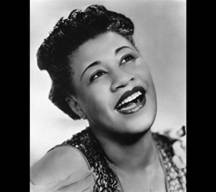
There was nothing she couldn't do, superbly. Ella Fitzgerald was also a magnificently humble woman whose ego never got in the way of presenting a song to its best advantage. Unlike other jazz greats like Billie Holiday (my other favorite,) she had a personal life unmarred by drug abuse or scandal of any kind.
When I think of a person who accomplished what she was meant to do in life, Ella Fitzgerald comes to mind first. But the cost was high. Ironically, as she sang of perfect romance and provided the backdrop for numberless other peoples' romances, she never experienced it herself.
Her first marriage, to a drug dealer, was annulled a short time later. Her second, to legendary bassist Ray Brown, lasted four years, during which time the couple adopted a baby boy born to her sister, Frances. They named him Ray Brown, Jr.
I can't remember how many times I fell in love to Ella's music. It was impossible not to love whoever I was with when she was singing. Eventually, I learned to distinguish my love for her and her incredible voice from the lucky shooters across the romantic little tables from me.
Born in 1918, she died of diabetes in 1996 at the age of 78. In doing her life's work so gloriously, she enhanced the lives of millions of others. We should all be so blessed.

A few days after her death, The New York Times columnist Frank Rich wrote that in the songbook series, Fitzgerald "performed a cultural transaction as extraordinary as Elvis's contemporaneous integration of white and African-American soul. Here was a black woman popularizing urban songs often written by immigrant Jews to a national audience of predominantly white Christians."

And that's why the lady has a stamp.
R.I.P., Ella. You will be loved forever.